Coffee encyclopaedia · Complete journey
From seed to Sip.
Follow coffee all the way from a seed in nursery soil to the finished cup — through flowering, harvest, processing, drying, trade, roasting, grinding and brewing.
One connected chain
Coffee is an agricultural product long before it is a café drink.
Coffee is a relay race with rather a lot of opportunities to drop the baton. Each stage hands something to the next: good farming cannot rescue careless drying, brilliant roasting cannot restore damaged green coffee, and excellent beans can still be flattened by a bad grinder and enthusiastic boiling water.
Stage 01
01
The seed
Coffee begins as a seed inside a fruit. Before it becomes something to roast, grind or brew, that seed has to germinate and establish a healthy root system.
Stage 02
02
The nursery
Young coffee plants are usually raised under controlled shade before they are strong enough for the field. Nursery care gives the plant its first real start.
Stage 03
03
The coffee tree
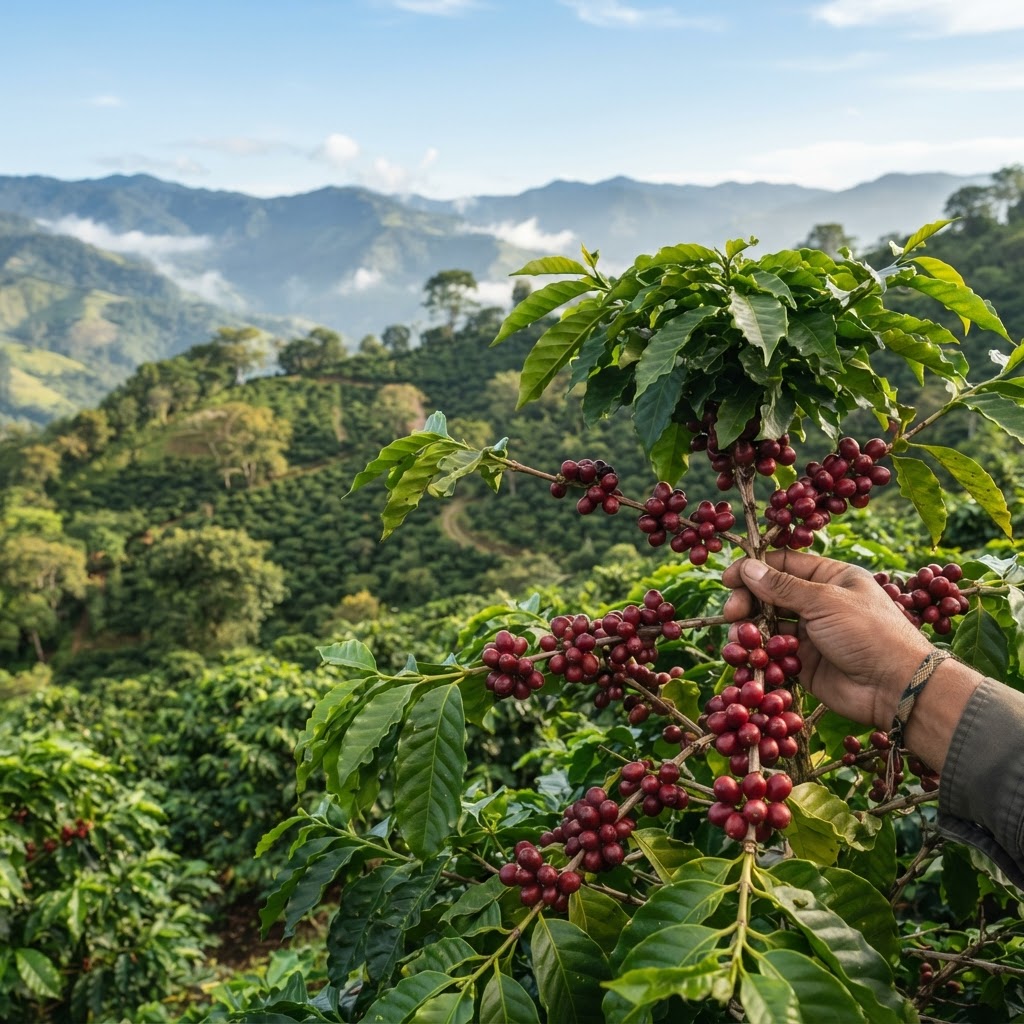
A mature coffee plant is a woody evergreen with glossy leaves and fruit carried along its branches. Variety, climate, soil, pruning and farming all shape what comes next.
Stage 04
04
Flowering
Coffee flowers are delicate, white and short-lived. Rainfall and weather can trigger flowering, setting up the fruiting cycle that will eventually produce ripe cherries.
Stage 05
05
Inside the cherry
The drink we call coffee comes from the seeds of a fruit. Skin, pulp, mucilage, parchment and seed all matter because processing decides how much of that fruit remains around the seed, and for how long.
Stage 06
06
Ripening
Cherries do not all ripen at once. Green fruit gradually changes colour and chemistry, and selective harvesting aims to pick cherries when they are properly ripe rather than simply convenient.
Stage 07
07
Harvest
On many farms, ripe cherries are picked by hand. That makes harvesting a skilled judgement rather than a purely mechanical step, especially where quality depends on selecting fruit at the right stage.
Stage 08
08
Sorting
Once cherries arrive from the field, obvious defects and underripe or damaged fruit can be removed. Sorting is one of the earliest chances to protect quality before processing begins.
Stage 09
09
Choosing a processing route
Washed, natural and honey processing take different routes through fruit removal, fermentation and drying. None is automatically superior; each changes how the seed reaches the drying stage and can influence flavour and texture.
Stage 10
10
Fermentation
Fermentation begins as microbes act on sugars and fruit material around the coffee seed. Producers control time, temperature, water and vessel conditions to steer the process rather than simply leave it to chance.
Stage 11
11
Drying
Coffee has to be dried carefully and evenly before storage. Raised beds, patios and mechanical dryers can all work; the aim is stable moisture without mould, over-fermentation or harsh drying damage.
Stage 12
12
Dry milling
Once dry, coffee still needs cleaning, hulling, grading and sorting. Dry mills turn processed parchment or dried cherry coffee into the clean green seeds that can be prepared for trade.
Stage 13
13
Green coffee
Before roasting, coffee is pale green rather than brown. At this stage buyers assess size, density, defects, moisture, origin and cup quality before deciding what is worth buying and how it might be roasted.
Stage 14
14
Trade and transport
Green coffee moves from farms and mills into warehouses, sacks, containers and export systems. Traceability can be preserved well or badly through this stage, which is why origin information matters.
Stage 15
15
Roasting
Roasting transforms a hard green seed into the aromatic brown bean we recognise. Heat drives physical and chemical changes that create sweetness, acidity, bitterness, roast character and hundreds of aroma compounds.
Stage 16
16
Grinding
Grinding exposes far more surface area to air and water. Grind size controls how quickly flavour can be extracted, which is why the right grind depends on the brewing method.
Stage 17
17
Brewing
Brewing is controlled extraction: water dissolves flavour from ground coffee. Dose, grind, water, temperature, contact time and agitation all alter what reaches the cup.
Stage 18
18
The cup
Everything upstream converges here. Variety, place, harvest, processing, drying, roasting, grinding and brewing all leave traces in the finished drink — which is why tasting coffee can be read backwards, from sip to seed.
Keep exploring
Once you know the journey, start pulling at the threads.
The journey explains how coffee gets here. The Atlas tells you what place changed along the way, and brewing is where you discover how much damage — or brilliance — you can add at the very end.